
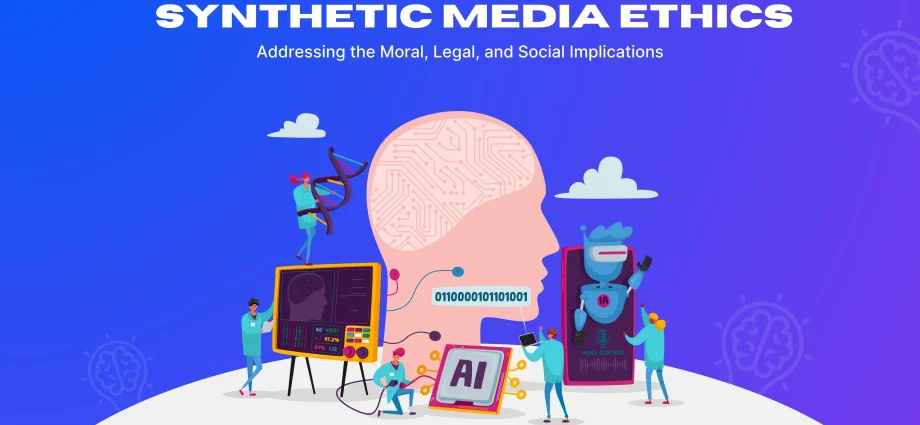
Let’s be honest—the line between what’s real and what’s manufactured is blurring faster than ever. You’ve probably seen it: a photorealistic image of an event that never happened, a video of a politician saying words they never uttered, or an article that reads perfectly but has no human author. This is the world of AI-generated content and synthetic media. And while the tech is dazzling, it’s the ethical implications that keep many of us up at night.
Here’s the deal. We’re not just talking about fancy tools. We’re talking about a fundamental shift in how information, art, and trust are created. So, let’s dive into the ethical maze—no easy answers here, just the crucial questions we all need to be asking.
The Core Dilemma: Authenticity vs. Automation
At its heart, the ethical debate swirls around authenticity. When a machine can produce a convincing news article, a beautiful painting, or a heartfelt poem, what happens to the value of human effort? It’s a bit like finding out your prized handmade sweater was actually cranked out by a loom in a factory. The product might look the same, but the story behind it—the intention, the struggle, the human touch—is utterly different.
This creates a massive tension. On one hand, AI can democratize creation, helping people overcome technical barriers. On the other, it risks flooding our world with content that’s hollow at its core—content without a soul, you might say. The ethical use of AI in content creation hinges on transparency. Are we being told when the “artist” is an algorithm?
Where the Rubber Meets the Road: Key Ethical Concerns
Okay, so authenticity is fuzzy. But the problems get far more concrete. Let’s break down the big ones.
1. Deception and the Erosion of Trust
This is the biggie. Synthetic media, especially deepfakes, can be weaponized for misinformation. Imagine a fake audio clip of a CEO admitting to fraud, triggering a stock crash. Or a fabricated video of a conflict zone, swaying public opinion. The potential for harm in politics, journalism, and personal lives is staggering.
The result? A crippling erosion of trust. We could enter a state where people dismiss genuine evidence as fake—a phenomenon called the “liar’s dividend.” If anything can be faked, then nothing can be believed. That’s a dangerous foundation for any society.
2. Consent and Identity Theft
Here’s a chilling scenario. Your face, scraped from social media, is grafted onto someone else’s body in a video without your permission. Your voice is cloned to say things you’d never say. This isn’t sci-fi; it’s happening. The ethical implications of AI-generated content here are stark: it’s a violation of bodily autonomy and consent. It turns a person’s identity into a puppet for someone else’s script.
3. Bias and Amplified Inequality
AI models learn from existing data—data created by humans, with all our flaws and biases. So, an AI asked to generate images of “CEOs” might default to showing older white men. Ask it to write about “nurses,” and it might lean heavily female. This doesn’t just reflect bias; it amplifies and automates it at a terrifying scale, reinforcing harmful stereotypes under a veneer of technological neutrality.
4. Intellectual Property and the Creative Soul
Who owns an AI-generated piece? The person who typed the prompt? The company that built the model? What about the thousands of artists whose copyrighted work was used, without compensation, to train the AI in the first place? It’s a copyright quagmire. For working creatives, it feels like having their life’s work used to build a machine that might then replace them. That’s… a tough ethical pill to swallow.
Navigating the Gray: Potential Paths Forward
So, is it all doom and gloom? Not necessarily. But navigating this requires proactive, thoughtful steps—from all of us.
| Ethical Principle | Practical Action | Who’s Responsible? |
| Transparency | Clear labeling of AI-generated content (watermarks, metadata). | Creators, Platforms, Publishers |
| Consent & Privacy | Laws prohibiting non-consensual synthetic media; robust opt-out for data training. | Legislators, Tech Companies |
| Accountability | Developing detection tools; establishing clear lines of liability for harm. | Researchers, Legal Systems |
| Equity & Fairness | Diverse training data audits; supporting human creatives in the AI economy. | AI Developers, Industry Bodies |
Honestly, regulation is lagging way behind the tech. We need new frameworks. Some ideas floating around include:
- Mandatory Disclosure Laws: Like nutrition labels for content. If it’s AI-made, it has to say so.
- Stronger Copyright Adaptation: Clarifying fair use in model training and establishing royalty models for training data.
- Investment in Detection: Building the “antibodies” for our digital immune system. This is a cat-and-mouse game, but a critical one.
The Human in the Loop: Our Role in This
Beyond laws and tech solutions, there’s us—the consumers, the sharers, the audience. Ethical consumption of synthetic media starts with a healthy dose of skepticism. Get in the habit of checking sources. Ask yourself: who benefits from this piece of content? Does it seem off? Pause before you share that shocking video.
And for creators using AI tools? The ethical path is about partnership, not replacement. Use AI to brainstorm, to overcome writer’s block, to handle tedious tasks. But infuse the final product with your own perspective, your edits, your humanity. Be the curator, not just the prompt-typer.
Look, this technology isn’t going away. It’s a tool—incredibly powerful, deeply ambiguous. A hammer can build a house or break a skull. The ethical implications of AI-generated content force us to decide, collectively, what we want to build. Will we build a world of convenient deception and automated plagiarism? Or one of augmented creativity, where human ingenuity is amplified, not replaced?
The answer isn’t in the code. It’s in us.